COMPLETE GUIDE
US College System
Everything you need to know about US college soccer. NCAA, NAIA, NJCAA, divisions, scholarships, recruiting calendar and academic requirements.
 D1D2D3
 D1D2D3D1D2D3D1D2D3
The athletic level of the United States
Federico explains what competing in the US college system is really like
5 questions. 5 answers. Together with Krysthen.
A space to share some of the questions we receive most often and, above all, our perspective from experience on each one of them.
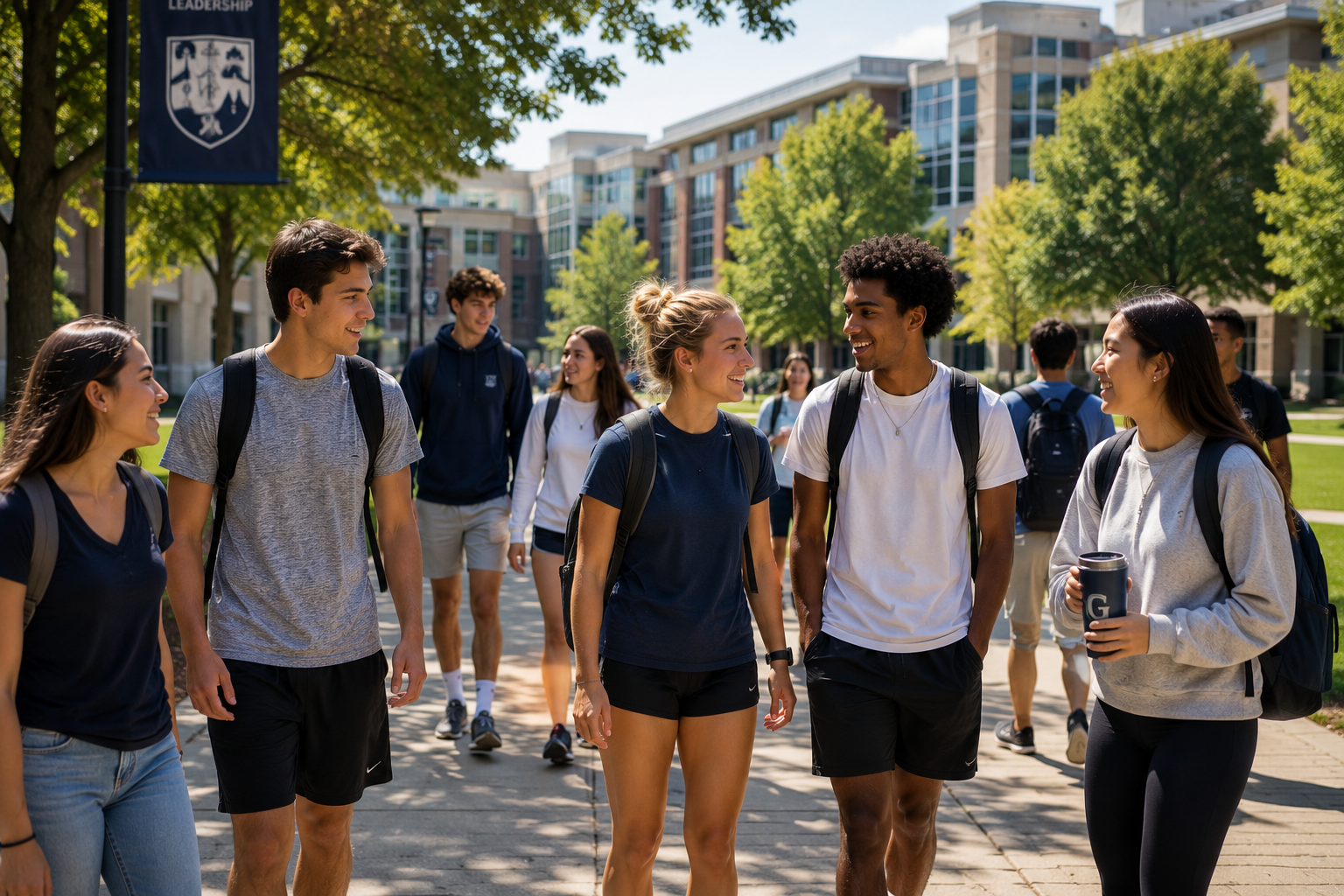
Why study and play in the US
Compete where the standard is highest
The US college system demands discipline, consistency and performance, raising the level of the student-athlete in every training session and competition.
Turn your talent into a strategic advantage
Soccer stops being just passion and becomes a tool to build sustainable academic and professional opportunities.
Access resources that boost your performance
Top-tier infrastructure, technology, specialized coaching staff and athletic planning designed to maximize your development.
Make decisions that build your future
With FROZ Sports' guidance, the process stops being uncertain and becomes a well-executed strategy.
Associations comparison table
D1D2D3- Level:
- Very high · elite
- Scholarships:
- Full or partial (highly competitive)
- Eligibility:
- Strict + NCAA Eligibility Center
- # univ.:
- +350
- Level:
- High
- Scholarships:
- Partial (athletic + academic combination)
- Eligibility:
- Moderate + NCAA Eligibility Center
- # univ.:
- +300
- Level:
- Medium-high
- Scholarships:
- Academic/financial only (no athletic)
- Eligibility:
- More flexible, no NCAA EC
- # univ.:
- +400
- Level:
- Medium-high
- Scholarships:
- Athletic and academic combined
- Eligibility:
- NAIA Eligibility Center (flexible)
- # univ.:
- +250
- Level:
- Variable (medium to high)
- Scholarships:
- Athletic (per program)
- Eligibility:
- Accessible, development-focused
- # univ.:
- +500
How athletic scholarships work
If you think it's all "full scholarship or nothing," you're missing many alternatives and how the game really works.
Full vs Partial: not black or white
Full scholarship
Covers nearly everything: tuition, housing, meals, books. They are few and highly competitive.
Partial scholarship
Covers part of the costs. Most athletes enter through this path.
In soccer the norm is not getting a full scholarship from day one, but building it.
Equivalency Sport: the "pie" is split
Soccer is an equivalency sport. The program has a total scholarship amount but the coach decides how to split it.
- A team may have the equivalent of 9.9 full scholarships.
- But it has a roster of 25-30 players.
- Scholarships are distributed (30%, 50%, 70%, etc.) by level, position and player value.
It's not how much is available to assign to each student-athlete… it's how you position yourself within the team.
Stacking: when scholarships combine
- Academic scholarships (GPA, grades).
- Institutional aid.
- Grants or internal university funds.
It's not about "getting a scholarship." It's about building a package. Your ideal profile combines athletic level + academic performance + application strategy + correct timing.
Recruiting calendar
- 14–16 years
Stage 1
Preparation
Constant athletic development. Start building your profile. First indirect contact. Common mistake: waiting until you're 'good enough' to start.
- 15–16 years
Stage 2
First contact
Positioning process. Contact coaches directly. NCAA: contact windows. NJCAA and NAIA: more flexible. This is where it's defined who sees you.
- 16–17 years
Stage 3
Evaluation and follow-up
Coaches review videos and progress. More direct conversations. It's not just talent: it's consistency + timing.
- 16–17 years
Stage 4
Offers
Partial or full scholarships. Conversations about role on the team. Parallel academic evaluation.
- senior year of high school
Stage 5
Signing
Commitment signing (LOI, NLI). Secure your spot.
- +
Stage 6
Admission and Visa
Admission letter. I-20 form. F-1 Visa.
- +
Stage 7
Arrival and adaptation
Team integration. Academic and cultural adjustment.
Recruiting is not luck. It's timing + strategy + execution.
Academic requirements
NCAA Eligibility Center
- If applying to NCAA D1 or D2, registration is mandatory.
- They validate: GPA, courses taken, general academic level, amateur sport history.
GPA
- NCAA D1: high (approx. 3.0+ minimum).
- NCAA D2: medium (approx. 2.8+).
- NAIA / NJCAA: more flexible.
TOEFL / Duolingo / IELTS
- TOEFL iBT: traditional standard.
- Typical ranges NCAA / NAIA: 70–90 TOEFL approx.
- NJCAA: 60–75 TOEFL approx.
SAT / ACT
- Many universities are test-optional.
- Some consider them for academic scholarships or more competitive admission.
Europe vs US
Two models, two different logics. In Europe, talent goes pro early within academies. In the US, the path combines university competition + academic development… and the MLS SuperDraft is largely fed by that system.
Complementary structures
Europe: academies → contracts → first team. US: high school → college soccer → MLS / USL.
The SuperDraft is still college-first
Over 80% of recent picks come from NCAA/NAIA/NJCAA.
Why college is relevant
More than 200 NCAA D1 programs. Structured seasons, full coaching staff, constant scouting.
Homegrown vs Draft
MLS clubs also promote players from their own academies, but college expands the base.
Advantages for international profiles
Exposure to MLS and USL scouts. Development in a competitive environment. Access to university education.
Why the draft comes from college
It concentrates evaluated talent volume. Organized competition. A bridge between development and pro soccer.
In Europe you develop within a club. In the US you can develop within a system.
Ready to discover your real potential?
Complete your Free Discovery Assessment and get a first strategic reading of your profile in less than 72 hours.